Bookmark and Share
Texas Outside review of Grapevine Golf Course - Mockingbird Course Return to Golf Home Page Go BackGo ForwardHome to Texas OutsideContact UsSearch Texas OutsidePrint Texas Outside
Free Texas Outside Newsletter!
Search Texas Outside!

Grapevine Golf Course - Mockingbird Course
Texas Outside Rating: 8.7
27 Holes - Golf - Public
Grapevine
817 410-3377
Website
Locate This Course

Img_5108 Img_5116 Img_5122
 
Date Played: October 30, 2010
Front Nine Rating: 8.7 Stars
Back Nine Rating: 8.7 Stars
Approximate Weekend Price Range: $36.00 to $50.00
Brief Description:

Grapevine Golf Course has 27 holes of some very good golf.  The Dallas Morning News rated it #19 of the "Top 25 Best Daily Fee Courses" and Avid Golfer rated it in the "Top 50 Public Courses" as well as a "Best Value Under $50."   On the weekends all three nines are in play and the pro shop determines with two nines you'll play during your round.  During the week, one of the nines is out of play for maintenance. 

Byron Nelson and Joe Finger designed the original 18 (Mockingbird and Pecan) which opened in 1979.   D. A. Weibring was hired for a major expansion and modernization renovation project for the original 18 and to add an additional 9 holes which opened as Bluebonnet in the fall of 1999. 

Each nine has its own unique personality and characteristics but common to all three are excellent conditions, white soft sand bunkers, memorable and fun holes,  reasonable rates, and low flying aircraft on their approach to DFW.   Each nine has 4 sets of tee boxes and regardless of which nines you play, the course is a little short at 6983 yards.   Mockingbird is the flattest, Bluebonnet has surprising elevation changes, and Pecan is the hardest and demands accuracy off the tee box and on a number of the approach shots. 

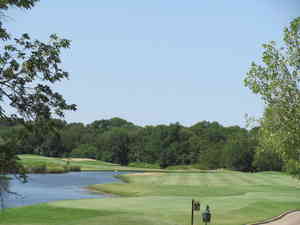
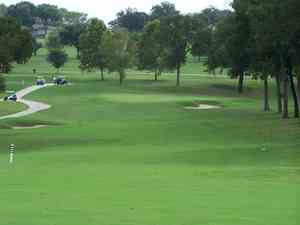
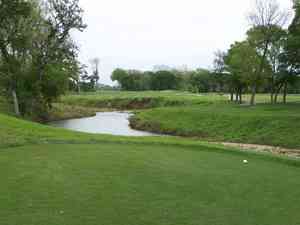
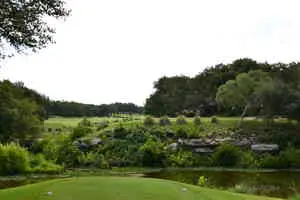
Mockingbird offers you an opportunity to score well and have a very relaxing and enjoyable round.  The fairways are ample, the first cut is wide and playable, and there's not a lot of trouble.  The scorecard shows water on 8 holes but it really only comes into play on 5 holes.  The fairways are all tree lined and if you really spray the ball, forget about it and get out a new one.  

There are some very fun holes on Mockingbird that you'll want to come back and play again, for example:

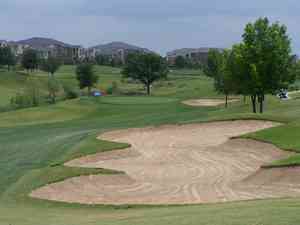
  • #3 looks pretty straightforward and easy from the tee box - it's only 386 yards but you need to nail the approach shot to avoid a huge deep swale and bunker on the left side
  • #5 is a 524 yard sharp dog leg left with a bunker in the middle of the fairway which means you need a good tee shot to avoid the trees on the left and the bunker and to position you to head toward the green on a narrow fairway with trees, a bunker, and water along the left side
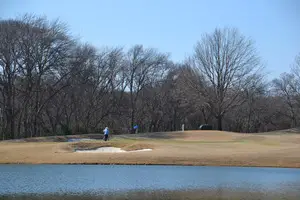
  • #6 is a short 319 yard par 4 but water on both sides of the fairway and a big bunker where the fairway turns right means you better choice the right club for your tee shot or you'll add a stroke to you score - and the approach also demands accuracy to avoid the two bunkers, mounds and trees behind the green, and the water along the right side
  • #9 is a beautiful finishing hole to a well protected uphill green

When we played in October, the fairways were just starting to go dormant but they were still in near perfect condition.  They are ample off the tee box and the first cut was wide and playable - after that you're history.  Most of the fairways are flat with a minimum amount of contour.  They are all tree lined with no homes along any of them. 

The TIF Eagle greens are average to large with both slope and undulation.  We thought they were pretty fast (11 or so) when we played and very true.  They held the ball well, rolled smooth, and were pretty easy to read. 

The bunkers on Mockingbird are about average size and depth and they are filled with soft white sand that's thick.  The lips aren't that high and we found getting out of them was not a problem. 

Bottom line - Mockingbird is one of the those tracks you love to play when you need to have a fun, relaxing, and low scoring round at a very reasonable rate.   A great nine.

The slope and rating are based on playing the Mockingbird and Bluebonnet nines. 

 
Img_5125 Img_5118 Img_5111
Texas Outside Scorecard for Grapevine Golf Course - Mockingbird Course
Beauty:  
Difficulty:  
Variety:  
Fun Scale:  
Value:  
Condition:  
Other Good Information:

Designer/Architect: Redesigned by D.A. Weibring
Beware of water on 7 holes and the 24 sand traps.
The pro shop has the basics, the grill has a good menu, service is okay, and the practice facilities are more than adequate.
Condition of the greens is 8.5 and the green difficulty is 7.5 out of 10.
Type of Greens: TIF Eagle
Walkable: Yes
GPS: No
Scorecard
Img_5119

Course Yardage, Slope, and Rating:

Tee Box Yardage Rating Slope Par
Gold 3,412 73.9 133 36
Blue 3,188 71.4 130 36
White 2,959 69.4 121 36
Red 2,432 70.1 117 36
Img_5117


Here's How Texas Outside Determines the Scorecard Rating

The Texas Outside rating scale ranges from 1 to 10 – a perfect 10 course would be something like this:  links along a cliff overlooking the Pacific ocean and bordered by tall trees; lush fairways on rolling hills with lots of natural hazards; water (which is crystal clear) on most of the holes; immaculate greens (but they are undulating and tough); lots of variety and character (each hole is completely different and includes blind shots, elevation changes, doglegs, and significant challenges); perfectly manicured traps with the whitest and prettiest sand you’ve ever seen; a nice club house with great food and a 19th hole; a GPS; plenty of beverage carts or your own cooler and ice; and it only costs $40 bucks! What this means is that you probably won’t find any 10s in Texas – try Cabo San Lucas, Pebble Beach, or some of the Hawaii courses! 
Texas Outside rates courses on the following:

  • Beauty – tall trees, rolling hills, beautiful houses, waterfalls, and similar stuff would score high; a 1 would be flat, bushes or cactus instead of trees, and some grass but mostly weeds
  • Difficulty – a straight, 300 yard par 4 with no traps or hazards, no out of bounds or water would probably get a 1; if it is a 460 yard par 4 over two ravines, with water along one side, natural hazards on the other, strategically placed traps or that dreaded tree right in the middle of the fairway, we are talking a 10. 
  • Variety – what would you give a course where all the holes looked and played exactly the same (“I thought we just played that hole!”); were side-by-side, which is good for finding or dodging other people’s balls, but not much fun; and you can see the flag from every tee box?  That’s right, it gets a 1.
  • Fun Scale – a 10 is where you walk off the course and say “now that was fun” and you can’t wait to get back, or you immediately turn around and play another 18 holes
  • Value – a 5 is $50 to $60, a 10 is $20 to $30, and 1 is $200 or so – of course all of this is dependent upon how you liked the course.  For example, if a run down, boring municipal course, with six players on each hole was only $10; it would still get a value rating of 1.
  • Condition – this one’s pretty easy – what condition are the fairways. A 10 commands very lush perfectly manicured fairways, compared to a 1, which has fire ants, weeds, and more dirt than grass!
  • Condition of Greens and Difficulty – very hard to read greens with lots of undulation and tough pin placement, rate very high on the difficulty scale.  Condition is self-explanatory.  

All of the above determines the overall score for the golf course.  In other words, we like courses that are pretty, fun, very challenging with a lot of variety, and fairways and greens in excellent condition – all for $40.  We also tend to play the courses that are affordable for the masses, which means in the $30 to $80 range. We rate hard and we haven’t found a 10 in Texas yet – don’t worry we haven’t given up and we’re still looking. 


Sign Up For Our Free Newsletter Email: