Texas Outside Facebook

Review of Delaware Springs Golf Course

Delaware Springs Golf Course
Texas Outside Rating: 8.3
18 Holes - Golf - Public
Burnet
512 756-8471
Website
Locate This Course
Online Tee Times Stay & Play

Img_1746 Img_1730 Img_1751
 
Date Played: July 06, 2010
Front Nine Rating: 8.5 Stars
Back Nine Rating: 8.0 Stars
Approximate Weekend Price Range: $31.00 to $48.00
Where To Get Coupons: their website, Golf512.com

Brief Description:

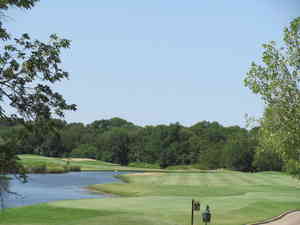
Delaware Springs Golf Course opened for play in 1992 and is a fun and somewhat challenging course and an excellent value.  Delaware Springs was chose by Golfweek in 2008 as one of the "Best Courses You Can Play" and was given 4 out of 5 stars by GolfReview.com.  We think is one of the best municipal courses in Texas.  

The course designers, Dave Akland and Dan Procter, really put some thought into the course and laid it out to take advantage of the natural terrain and gently rolling Texas Hill Country.  They named each hole after some feature like #5 named "Mountain View" because of it's view of some of the Hill Country Mountains or "Roon the Bend" because of it's sharp dogleg right.  The course is located in a nice golf community, but few homes line the holes. 

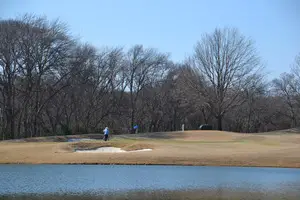
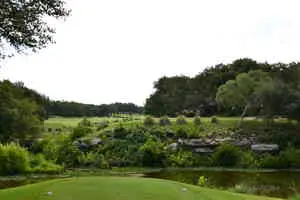
By today's standards, Delaware Springs is a little short from each of the 4 tee boxes with yardages ranging from 4931 to  6981 from the tips.  Even though it's a little short, it still will challenge players of all skill levels thanks to blind shots, lots of dog legs requiring a precise drive to make the turn, some elevation changes, and strategically placed bunkers.  You'll find water on 6 holes, but we found it pretty easy to avoid. 

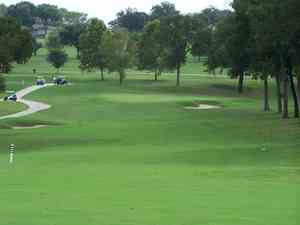
The fairways, which were in excellent condition (lush, smooth, and green), were ample and forgiving, and the rough was thin and playable - but miss the rough and you'll most likely lose your ball in the native grass and trees.  

Both nines are good, however we thought the front nine was a little prettier, a stroke or two harder, and more interesting. You'll encounter some fun and challenging holes, like  Delaware Spring's #17  which is listed  in Jeff Barr's "1001 Golf Holes You Must Play Before You Die.  At first glance this is a birdie waiting to happen. But, as is often the case in this tricky game, first glances can be deceiving.  This is a devilish little hole, and it's deception is delicious".  Some of the other fun holes include:

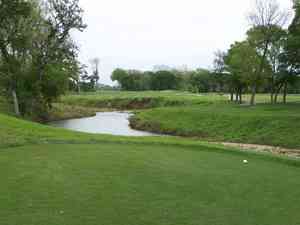
  • #1, a 524 yard par five with a downhill drive that needs to be precise to make the turn left and avoid the driveable creek which crosses the fairway
  • # 6 is a narrow tree lined fairway which requires a precise shot to position you to avoid the large tree in the middle of the fairway and to nail the uphill shot to the green
  • #9 is a short 325 par 4 dog leg right that requires excellent club selection and offers a good risk reward shot if you think you can carry the trees and hit the narrow fairway - a good opportunity to walk into the club house with a birdie

The greens range in size from huge to about average and have minor slope and undulation.  They held well, were about average speed, very true, and easy to read.  We found putting to be relatively straightforward.  The majority of the greens were in above average condition however some had some rough spots thanks to a harsh winter. 

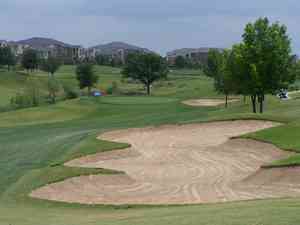
The bunkers also range in size from some small pot bunkers to some large strategically placed traps.  Most were in good shape but the sand was thin, gritty, and hard.  

Bottom line - a very good course with great conditions and an excellent value.  One of the best munis in Texas.

If you're coming into town and like to fish, call Texas Professional Fishing Guides and ask them about their
"Fish & Chips" package which includes a round of golf at Delaware Springs and a fishing trip - and if you need lodging they can set that up for you also. 

 
Img_1749 Img_1754 Img_1747
Texas Outside Scorecard for Delaware Springs Golf Course
Beauty:  
Difficulty:  
Variety:  
Fun Scale:  
Value:  
Condition:  
Other Good Information:

Designer/Architect: Dave Axland & Dan Proctor
Beware of water on 6 holes and the 31 sand traps.
The pro shop has the basics, the grill serves an excellent burger, and the practice facility is ok.
Condition of the greens is 9.0 and the green difficulty is 7.0 out of 10.
Type of Greens: TIF Dwarf
Walkable: Flat but far between holes
GPS: No
Img_1743

Course Yardage, Slope, and Rating:

Tee Box Yardage Rating Slope Par
Gold 6,891 72.0 127 72
Blue 6,328 70.3 121 72
White 5,829 68.2 110 72
Red 4,931 66.8 106 72
Img_1721


Here's How Texas Outside Determines the Scorecard Rating

The Texas Outside rating scale ranges from 1 to 10 – a perfect 10 course would be something like this:  links along a cliff overlooking the Pacific ocean and bordered by tall trees; lush fairways on rolling hills with lots of natural hazards; water (which is crystal clear) on most of the holes; immaculate greens (but they are undulating and tough); lots of variety and character (each hole is completely different and includes blind shots, elevation changes, doglegs, and significant challenges); perfectly manicured traps with the whitest and prettiest sand you’ve ever seen; a nice club house with great food and a 19th hole; a GPS; plenty of beverage carts or your own cooler and ice; and it only costs $40 bucks! What this means is that you probably won’t find any 10s in Texas – try Cabo San Lucas, Pebble Beach, or some of the Hawaii courses! 
Texas Outside rates courses on the following:

  • Beauty – tall trees, rolling hills, beautiful houses, waterfalls, and similar stuff would score high; a 1 would be flat, bushes or cactus instead of trees, and some grass but mostly weeds
  • Difficulty – a straight, 300 yard par 4 with no traps or hazards, no out of bounds or water would probably get a 1; if it is a 460 yard par 4 over two ravines, with water along one side, natural hazards on the other, strategically placed traps or that dreaded tree right in the middle of the fairway, we are talking a 10. 
  • Variety – what would you give a course where all the holes looked and played exactly the same (“I thought we just played that hole!”); were side-by-side, which is good for finding or dodging other people’s balls, but not much fun; and you can see the flag from every tee box?  That’s right, it gets a 1.
  • Fun Scale – a 10 is where you walk off the course and say “now that was fun” and you can’t wait to get back, or you immediately turn around and play another 18 holes
  • Value – a 5 is $50 to $60, a 10 is $20 to $30, and 1 is $200 or so – of course all of this is dependent upon how you liked the course.  For example, if a run down, boring municipal course, with six players on each hole was only $10; it would still get a value rating of 1.
  • Condition – this one’s pretty easy – what condition are the fairways. A 10 commands very lush perfectly manicured fairways, compared to a 1, which has fire ants, weeds, and more dirt than grass!
  • Condition of Greens and Difficulty – very hard to read greens with lots of undulation and tough pin placement, rate very high on the difficulty scale.  Condition is self-explanatory.  

All of the above determines the overall score for the golf course.  In other words, we like courses that are pretty, fun, very challenging with a lot of variety, and fairways and greens in excellent condition – all for $40.  We also tend to play the courses that are affordable for the masses, which means in the $30 to $80 range. We rate hard and we haven’t found a 10 in Texas yet – don’t worry we haven’t given up and we’re still looking.